
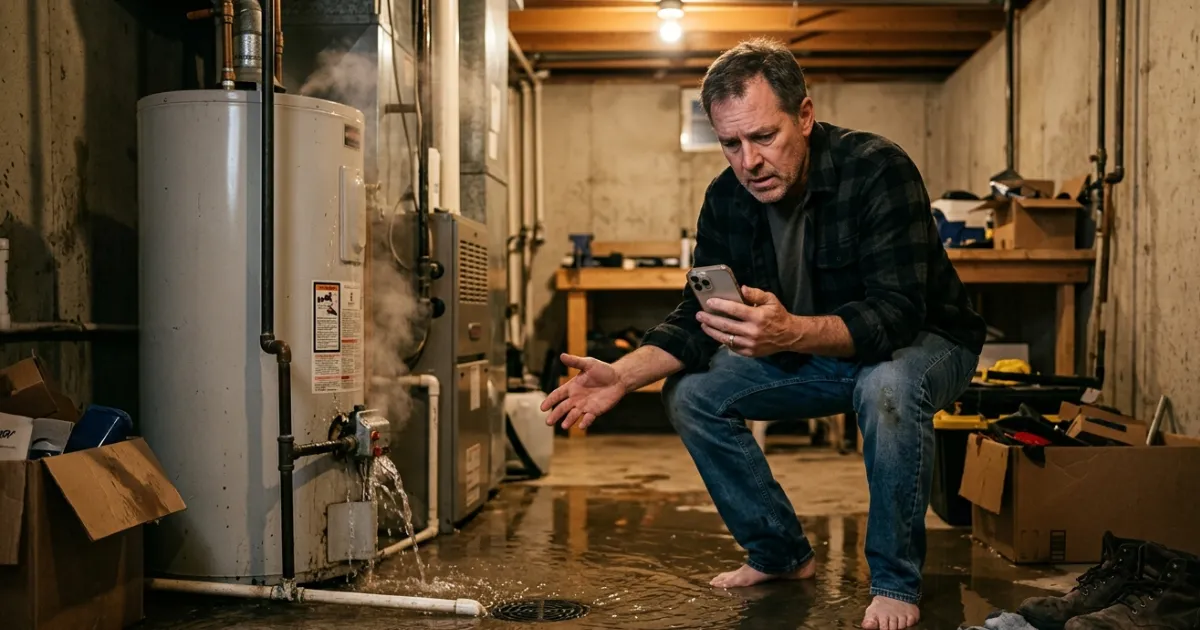
I remember the exact moment my water heater burst on a Tuesday night in January.
It wasn’t a small drip. It was a full-on flood spreading across my basement floor. And the repair quote I got the next morning? $1,800. Just like that.
Here’s the thing: most homeowners aren’t financially prepared for moments like that. And I don’t say that to judge anyone. I say it because the data backs it up in a big way.
According to a March 2026 study by Synchrony, 75% of homeowners have experienced an emergency home repair. And 40% of those incidents cost more than $3,000. But the real gut punch? 7 in 10 homeowners don’t have enough repair reserves to cover it.
So what do you do when your roof is leaking, your furnace dies, or a pipe bursts at 2 a.m.?
You figure out your financing options. Fast.
That’s exactly what this guide is for. I’m going to walk you through every real, practical emergency home repair financing option available in 2026. We’ll talk about personal loans, home equity products, government programs, and more. By the end of this, you’ll know exactly where to turn when your home throws a financial curveball at you.
Let’s get into it.
Why Emergency Home Repairs Are a Bigger Financial Problem Than You Think
Before I get into the actual financing options, I want to make sure you understand the full picture.
Because the numbers in 2026 are honestly a little alarming.

According to Angi’s State of Home Spending Report, the average household spent $1,143 on emergency repairs in 2025 alone. But that’s just the average. High-cost emergencies like foundation damage, full roof replacements, or septic system failures can easily run $8,000 to $30,000 or more.
And nearly 60% of homeowners say they’re putting off repairs because they simply can’t afford them. (That’s not a personal finance failure. That’s a structural gap in how most people plan for homeownership costs.)
The 1% Rule is the standard guidance: set aside 1% of your home’s value every year for maintenance and repairs. So if your home is worth $400,000, you’d need $4,000 a year sitting in reserve.
Most people aren’t doing that. Life gets in the way.
Wait, that’s not quite right. Let me rephrase that. It’s not just that life gets in the way. It’s that the average American homeowner already spends over $24,000 per year beyond their mortgage on insurance, taxes, utilities, and basic upkeep. There’s not always a lot left over to stash in a repair fund.
So when something breaks, financing isn’t a last resort. It’s often the only realistic option.
What Counts as an Emergency Home Repair?
Good question. And it matters because some financing options are specifically designed for urgent, health-and-safety repairs.
An emergency home repair is generally any damage or system failure that threatens your safety, makes the home unlivable, or will get dramatically worse if you wait.
Common examples include:
- A roof leak after a storm that’s actively letting water in
- A burst or frozen pipe causing water damage
- A failed HVAC system during extreme heat or cold
- Electrical faults or wiring failures (fire hazard)
- Sewage backup or failed septic system
- Structural damage from flooding, wind, or pests
- A broken water heater leaving you without hot water
These aren’t optional. You can’t just “deal with it later.” And some of them, like a slow roof leak, can turn a $500 problem into a $15,000 mold and structural nightmare within weeks.
So yes. Speed matters here. Financing matters here.
Emergency Home Repair Financing Options: The Full Breakdown
Here’s where I actually help you solve the problem.
There’s no single “best” option for everyone. The right financing depends on your credit score, how much equity you have, how fast you need the money, and how much the repair costs. I’ll break each one down clearly.
1. Personal Loans for Emergency Home Repairs
Honestly, personal loans are my top pick for most homeowners dealing with an urgent repair.
Here’s why. They’re fast, they don’t require collateral (which means your home isn’t on the line), and you can often get funded in 24 to 72 hours. Sometimes same-day if you have strong credit.
LightStream, a division of Truist Bank, is well known for funding personal loans the same day you’re approved. Upgrade approves borrowers with scores as low as 580. SoFi, Marcus by Goldman Sachs, and Discover also offer competitive personal loan products.
A typical personal loan for home repairs in 2026 might look like this:
- Loan amounts: $1,000 to $100,000
- APRs: 7% to 36% depending on credit
- Repayment terms: 1 to 7 years
- Funding speed: 1 to 3 business days (sometimes same day)
The trade-off? If your credit score is low, that interest rate can climb fast. And unlike a home equity loan, you won’t get a potential tax deduction on the interest.
But if you need money in 48 hours and don’t want to put your home up as collateral? Personal loans are the move.
Example: Let’s say your furnace dies in February and you need $4,500 to replace it. You apply online Monday morning through a lender like LightStream, get approved that afternoon, and have funds by Tuesday. The contractor shows up Wednesday. Problem solved.
2. Home Equity Loans
If you’ve built up equity in your home and you’re not in a rush (relatively speaking), a home equity loan can be one of the most affordable ways to finance a big emergency repair.
Here’s how it works. You borrow a lump sum based on the equity you’ve built. You repay it in fixed monthly payments with a fixed interest rate. And because the loan is secured by your property, interest rates are generally much lower than personal loans.
Home equity loan rates in 2026 typically fall between 6.5% and 9% for borrowers with solid credit. Compare that to a personal loan that might be 14% or higher for someone with average credit. That’s a meaningful difference on a $20,000 repair.
The catch? Your home is collateral. If you default, you risk foreclosure. And the approval process takes longer than a personal loan, usually two to six weeks. So if you need money tomorrow, this isn’t your option.
It’s like trying to use a savings account that requires a two-week notice period. The money is there, but you can’t grab it instantly.
Example: Your home needs $18,000 in foundation repairs. It’s serious, but not a 48-hour emergency. You take out a home equity loan at 7.5% APR over 10 years. Your monthly payment is manageable and you keep your savings intact.
3. Home Equity Line of Credit (HELOC)
A HELOC is similar to a home equity loan, but it works more like a credit card than a lump-sum loan.
You’re approved for a credit limit based on your equity. You draw from it as needed. You pay interest only on what you use. And rates are typically variable.
HELOCs are fantastic if your repair costs are still evolving. Maybe you’ve had an initial inspection but the contractor keeps finding more damage. A HELOC lets you draw funds incrementally as the project expands instead of guessing the total upfront.
The downside is that HELOC rates are variable, meaning they can shift as the market moves. That can be nerve-wracking if you’re carrying a balance long-term.
Also, if you already have a HELOC open and available, this is literally the fastest home equity option you have. You can draw from it immediately.
4. Cash-Out Refinance
A cash-out refinance is when you refinance your existing mortgage into a larger one and take the difference as cash. You can then use that cash for emergency home repairs.
This makes sense if current mortgage rates are close to or lower than your existing rate, and if you need a large amount, say $30,000 or more.
But fair enough, the math doesn’t always work. If your current mortgage rate is 3.5% and you’d have to refinance into a 7% loan to access your equity, that’s an expensive way to borrow money. Run the numbers carefully before going this route.
Closing costs alone (usually 2% to 5% of the loan amount) can eat into the value fast.
5. Government Programs for Emergency Home Repair
This is the section most homeowners don’t know enough about. And it can be genuinely life-changing for those who qualify.
USDA Section 504 Home Repair Program
The USDA’s Section 504 program offers loans at just 1% interest for very-low-income rural homeowners. That rate is not a typo. One percent.
The loans can go up to $40,000 and grants are available up to $10,000 for elderly homeowners (62 and older) to remove health and safety hazards. Loans and grants can be combined for up to $50,000 in total assistance, or $55,000 in presidentially declared disaster areas.
To qualify, you must be a homeowner-occupant in an eligible rural area and meet income limits. The USDA Eligibility Site lets you check your address.
HUD Title I Property Improvement Loans
HUD’s Title I program offers FHA-insured loans for home repairs and improvements. These are available through private lenders, but the FHA guarantee makes them accessible to borrowers who might not qualify for conventional loans.
For single-family homes, the loan limit is $25,000 with a maximum term of 20 years. These aren’t the fastest option, but they offer relatively accessible terms for low-to-moderate income homeowners.
HUD Section 203(k) Rehabilitation Mortgage
The 203(k) program lets homebuyers and homeowners roll up to $35,000 in repair costs into their mortgage. If you’re refinancing anyway, this can be a smart way to fund significant repairs.
FEMA Disaster Assistance
If your repair was caused by a federally declared natural disaster, FEMA grants can cover emergency home repair costs. These don’t need to be repaid. But they’re only available after specific disaster declarations.
Community Development Block Grants (CDBG)
CDBG funds flow from the federal government to local municipalities. Many cities and counties use these funds to run emergency home repair programs for low-to-moderate income homeowners. Check your local housing department to see what’s available in your area.
HOME Investment Partnerships Program
The HOME program provides grants to states and local governments to fund home improvements and affordable housing. Like CDBG, access depends on your location and local program administrators.
The Veterans Affairs (VA) Home Improvement Programs
If you’re a veteran or active-duty service member, the VA offers several adaptive housing grants that can cover repairs and modifications. The Specially Adapted Housing (SAH) grant and the Special Housing Adaptation (SHA) grant are the primary options for veterans with service-connected disabilities.
6. Credit Cards (Use With Caution)
I won’t pretend credit cards don’t exist as an option. For small, immediate emergencies under $3,000 to $5,000, they can work.
Especially if you qualify for a 0% introductory APR credit card. Some cards offer 12 to 21 months of zero interest. If you can pay off the balance within that promotional window, you’ve essentially borrowed money for free.
But here’s where you need to be careful. After that intro period ends, rates jump to 18% to 29% APR. That can snowball fast. And maxing out a card can seriously damage your credit utilization ratio, which directly impacts your credit score.
So yes, credit cards can bridge a short-term gap. But they’re generally not the right long-term solution for anything over $5,000.
7. Emergency Assistance Programs and Nonprofits
Depending on where you live and your financial situation, local nonprofits and community organizations may offer emergency home repair assistance.
Habitat for Humanity, for example, runs a Home Repair program in many communities. The Weatherization Assistance Program (WAP) through the Department of Energy helps low-income households improve energy efficiency, which can include HVAC and insulation repairs.
In New York, the HomeFix NYC program offers low-to-no-interest loans (potentially forgivable) up to $60,000 for homeowners earning up to 165% of Area Median Income. Programs like this exist in many major cities. You just have to dig for them.
The RESTORE program (also in New York) specifically targets emergency health and safety repairs for homeowners 60 and older.
8. Home Warranties
Okay, so this isn’t technically a financing option after the fact. But I’d feel irresponsible not mentioning it.
A home warranty is basically insurance for your major home systems and appliances. If your HVAC breaks down or your water heater fails, your warranty company sends a technician and you pay a service fee (usually $75 to $150) instead of the full repair cost.
Home warranty plans typically cost $500 to $1,500 per year. That’s a meaningful cost. But when you consider that an HVAC replacement alone can run $5,000 to $12,500, the math can work out in your favor.
If you don’t already have one, now’s a good time to think about it. Especially if your home’s major systems are aging.
Comparing Your Emergency Home Repair Financing Options
| Option | Speed | Credit Required | Home as Collateral | Best For |
|---|---|---|---|---|
| Personal Loan | 1 to 3 days | 580+ (varies) | No | Fast, mid-size repairs |
| Home Equity Loan | 2 to 6 weeks | 620+ | Yes | Large repairs, lower rates |
| HELOC (existing) | Same day | 620+ | Yes | Evolving repair costs |
| HELOC (new) | 2 to 6 weeks | 620+ | Yes | Flexible, ongoing needs |
| Cash-Out Refinance | 4 to 8 weeks | 620+ | Yes | Large amounts, if rates align |
| USDA Section 504 | Several weeks | Flexible | No (rural only) | Low-income rural homeowners |
| HUD Title I | 2 to 4 weeks | Flexible | No (under $7,500) | Low-to-moderate income |
| Credit Card | Immediate | Varies | No | Small repairs under $3,000 |
| Nonprofit/Grant | Varies | N/A | No | Low-income, specific programs |
How to Choose the Right Emergency Home Repair Financing Option
So how do you actually decide? Here’s the framework I use.
Step 1: Assess the urgency. Do you need money in 24 to 48 hours? Personal loans and existing HELOCs are your fastest options. Government programs take weeks. They’re great, but not for burst-pipe-at-midnight situations.
Step 2: Check your credit score. If your score is 680 or above, you’ll get the best personal loan and home equity rates. If it’s below 600, look at lenders like Upgrade or OneMain Financial, credit unions, or government programs with relaxed credit requirements.
Step 3: Calculate your home equity. Equity is your home’s current value minus what you owe. So if your home is worth $350,000 and you owe $220,000, you have $130,000 in equity. Most lenders let you borrow 80% to 85% of that. That’s potentially $104,000 to $110,500 available.
Step 4: Consider the repair size. Under $5,000 and you can pay quickly? Credit card or personal loan. $5,000 to $25,000 with time to plan? Personal loan or home equity loan. Over $25,000? Cash-out refinance or home equity loan might make more sense.
Step 5: Check your insurance first. Before you do anything else, call your homeowners insurance company. Storm damage, burst pipes, and certain types of water damage may be covered. Your deductible might be $1,000 to $2,000, but that’s better than paying $15,000 out of pocket.
Emergency Home Repair Services: What You Need to Know
Finding emergency home repair services can be stressful when you’re panicking. Here are some grounding principles.
Always get 2 to 3 quotes. Even in an emergency, get written estimates from at least two contractors. Prices can vary by 30% to 50% for identical work. I know it’s tempting to just hire the first person who shows up. But that first quote is often inflated because they know you’re in a bind.
Check licensing and insurance. Any contractor doing emergency home repair work should be licensed in your state and carry general liability insurance. Ask for both before anyone sets foot in your house.
Be cautious of “storm chasers.” After major weather events, unlicensed contractors flood affected areas offering fast, cheap repairs. Many are scams or do substandard work. Check reviews on Google, Angi, or the Better Business Bureau before you hire.
Mitigate damage while you wait. If your roof is leaking, put up tarps. If a pipe burst, shut off the main water valve. If your basement flooded, rent a pump. These steps limit damage and can save you significant money while you line up proper emergency home repair services and financing.
Practical Tips to Reduce Your Emergency Repair Financial Stress
And here’s where I want to go beyond just the loan types and give you something more actionable.
Build a dedicated home repair fund. I know this sounds basic. But even $50 a month into a high-yield savings account adds up. After two years, you’ve got $1,200 plus interest. After five years, you’re approaching $3,500. It won’t cover a roof replacement, but it covers a lot of smaller emergencies without debt.
Pre-qualify without hurting your credit. Most online lenders now allow soft-pull pre-qualification. That means you can check your rates and estimated loan amounts without any impact to your credit score. Do this before you need the money so you know exactly where you stand.
Know your insurance policy. The other day I was talking to a friend who had a major leak and didn’t call insurance because he assumed it wouldn’t be covered. It actually was. Read your policy. Know your deductible. Know what’s covered.
Understand your debt-to-income ratio (DTI). Lenders look at this number hard. DTI is the percentage of your monthly income that goes toward debt payments. Keeping it below 43% gives you the best shot at loan approval. This is something to manage proactively, not just when you need a loan.
Look into local housing authorities. Recently, more cities have expanded emergency repair programs. Many people don’t apply because they assume they won’t qualify. Check your city or county housing department before assuming you’re on your own.
Emergency Home Repair Loans for Bad Credit: You Still Have Options
Does bad credit close all the doors? No. Absolutely not.
Here’s the thing. Several lenders specifically serve borrowers with lower credit scores.
Upgrade approves personal loans for scores as low as 580. OneMain Financial offers secured loans with no stated minimum credit score if you can provide collateral. Credit unions are often more flexible than big banks because they’re member-owned and relationship-driven.
Government programs like USDA Section 504 and HUD Title I have relaxed or alternative credit requirements for low-income homeowners. The focus shifts more to income eligibility and property location than a three-digit score.
And actually, lenders dealing with lower-credit borrowers often put more weight on your debt-to-income ratio and employment history than your raw credit score. Steady income goes a long way.
So yes, bad credit makes it harder. But it doesn’t make it impossible.
What Happens If You Delay an Emergency Home Repair?
I want to be real with you about this.
Delaying an emergency repair to avoid financing almost always makes things worse financially.
A $500 roof leak that gets ignored can cause $15,000 in water damage, mold remediation, and structural repairs within weeks. A small foundation crack that goes untreated can turn into a full structural failure. A faulty electrical connection is a potential fire hazard.
And here’s something most people don’t think about: delayed repairs can void your homeowners insurance coverage. If an insurer determines that a known issue went untreated and caused additional damage, they can deny or reduce your claim.
Financing a $3,000 repair at 10% APR for two years costs you about $315 in interest. Waiting six months and letting the damage grow into a $20,000 repair? That’s a much steeper price.
The math almost always favors acting quickly.
Frequently Asked Questions
Can I get an emergency home repair loan with bad credit? Yes. Lenders like Upgrade approve borrowers with scores as low as 580. OneMain Financial offers secured loans with flexible requirements. Credit unions are often more lenient than banks. And government programs like USDA Section 504 have income-based eligibility rather than credit-score thresholds.
How fast can I get emergency home repair funding? Personal loans through online lenders like LightStream can fund the same day with good credit. Most personal loans fund within 1 to 3 business days. Existing HELOCs can be drawn immediately. Government programs typically take several weeks to process.
What’s the difference between a home equity loan and a HELOC? A home equity loan gives you a lump sum at a fixed rate, repaid in set monthly payments. A HELOC is a revolving credit line at a variable rate. You draw as needed and pay interest only on what you use. HELOCs are better when you’re not sure of the total repair cost upfront.
Does homeowners insurance cover emergency home repairs? It depends on the cause. Storm damage, burst pipes, and sudden water damage are often covered. Gradual leaks, wear and tear, and flooding (usually requires separate flood insurance) typically are not. Always check your policy and call your insurer before assuming something isn’t covered.
Are there free government grants for emergency home repairs? Grants (not loans) are available through programs like the USDA Section 504 (up to $10,000 for eligible elderly homeowners), FEMA disaster assistance after declared disasters, and local CDBG and HOME programs. Eligibility typically depends on income, location, age, and the nature of the repair.
What credit score do I need for a home equity loan? Most lenders require a minimum of 620 for a home equity loan or HELOC. The best rates usually go to borrowers with scores of 700 or higher. You’ll also typically need at least 15% to 20% equity remaining in your home after the loan.
How much can I borrow for an emergency home repair? It depends on the product. Personal loans go up to $100,000 with some lenders. Home equity loans depend on your available equity. Government programs cap at specific limits (USDA at $40,000 for loans, HUD Title I at $25,000). Most homeowners find they can access $5,000 to $40,000 through some combination of these options.
What should I do first when I have a home emergency? Mitigate further damage immediately (tarps, water shutoff, temporary patches). Call your insurance company to file or inquire about a claim. Get 2 to 3 written estimates from licensed contractors. Then choose your financing based on the amount needed and your credit profile.
Conclusion: You Have More Options Than You Think
Look, I know a home emergency feels overwhelming. One minute everything’s fine, and the next you’re staring at a $6,000 repair quote wondering how you’re going to pull that together.
But here’s the thing. You’re not out of options.
In 2026, the range of emergency home repair financing available to homeowners is genuinely broad. Personal loans fund in days without requiring home equity. Government programs like USDA Section 504 offer rates as low as 1% for those who qualify. HELOCs give you flexible access to equity you’ve already built. And nonprofit programs in many cities offer assistance that most people never think to look for.
The most important thing you can do is act quickly and think clearly.
Don’t delay a repair hoping the problem solves itself. It almost never does. Assess your credit, check your equity, review your insurance, and pick the financing option that fits the size and urgency of the issue in front of you.
So tell me: when you think about an emergency hitting your home tonight, do you actually know which of these options you’d use first?