
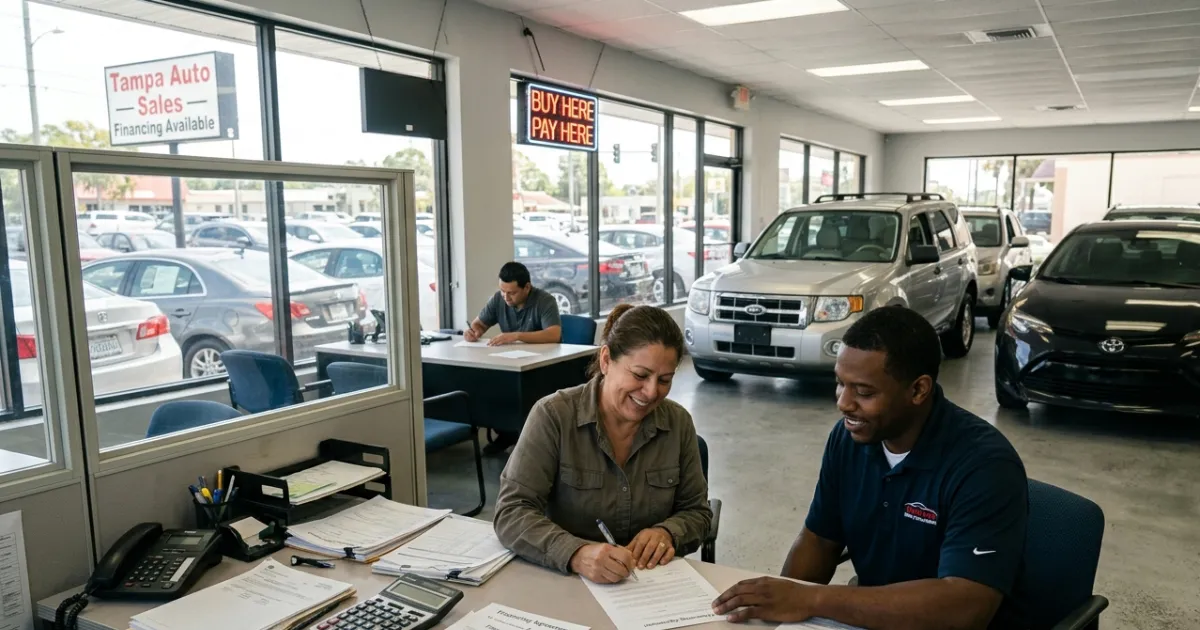
I want you to picture this. You walk into a car dealership. You find the exact vehicle you want. And then the salesperson says, “Don’t worry, we can handle the financing right here.” No bank. No waiting. No rejection letter in the mail.
That’s in-house financing. And honestly, it’s one of the most misunderstood options in personal finance today.
I’ve talked to people who swear by it. I’ve also talked to people who regret it deeply. The difference between those two groups usually comes down to one thing: whether they actually understood what they were signing before they signed it.
So let me break it down for you in plain language. I’ve spent time digging into how this works, who it helps, where it can hurt you, and when it actually makes sense. By the time you finish reading this, you’ll know exactly what you’re dealing with.
What Is In-House Financing?
In-house financing means the seller provides the loan directly to the buyer. The business selling the product becomes the lender too. You’re not going to a bank or credit union. You’re borrowing from the same company selling you the thing.
The term comes up most in auto sales. But it applies to furniture stores, medical practices, HVAC contractors, solar installers, and home renovation businesses too.
Here’s the thing: the business has to set up a legal lending entity to do this. It’s not just a handshake deal. There are contracts, interest rates, repayment terms, and legal obligations on both sides.
Wait, that’s not quite right. Let me rephrase that. It’s not just a lending arrangement. It’s a complete financial relationship between you and the seller. The seller earns money twice: once from the sale, and again from the interest on your loan. That second income stream is exactly why so many businesses are starting to offer it.
And yes, this is a growing trend. The global vendor finance market is expected to reach $312.4 billion by 2033. That’s not a small number. Businesses across every sector are choosing to manage financing themselves rather than hand customers off to a bank.
In-House Financing Meaning
If you’re still wondering what does in-house financing mean at the most basic level, here it is.
You want to buy something expensive. You don’t have the full cash right now. Instead of calling your bank, you apply for a loan directly with the store or dealer. They check your application using their own internal criteria. Then they approve you (or not) and set up a payment plan.

That’s it. The whole in-house financing meaning boils down to one idea: the seller becomes your lender.
And because they control the whole process, the rules are different from what you’d find at a bank. Sometimes better. Sometimes worse. Basically, it depends entirely on the specific business and your financial situation.
I’ll give you a practical example. Say you need a new HVAC system. It’s going to cost $8,000. You don’t have that sitting in your checking account. The HVAC company you’re using offers in-house financing. You fill out a short application, show proof of income, put down $800, and get approved the same afternoon. Your payments go directly to the HVAC company every month.
That’s in-house financing in the real world. Simple. Fast. But with terms you need to examine carefully.
How Does In-House Financing Work? The Full Process
So how does in-house financing work exactly? I’ll walk you through every step so there are no surprises.
Step 1: You Apply at the Point of Sale
When you’re ready to buy, the seller hands you a financing application. This happens in person, or sometimes online if the business has a digital setup. You provide basic personal and financial details: your income, employment status, monthly expenses, and sometimes your Social Security number for a soft or hard credit pull.
Step 2: The Seller Reviews Your Application
Here’s where it gets interesting. The business uses its own internal criteria instead of following rigid bank guidelines. They’re not necessarily pulling a strict FICO Score requirement. They look at things like your income stability, your down payment ability, your employment history, and how long you’ve lived at your current address.
Some sellers use automated decision tools or AI-powered credit assessment software now. Others still do it manually. Either way, the criteria are theirs to set.
Step 3: Terms Get Offered and Negotiated
If approved, the seller presents you with loan terms. This includes the interest rate, the monthly payment amount, the loan length, and the required down payment. And this is where you can often push back and negotiate. Sellers have more flexibility here than a bank does.
Step 4: You Sign a Loan Agreement
A written contract gets drawn up. It spells out every financial obligation clearly: the principal amount, the interest rate, the total repayment amount, the payment due dates, and what happens if you miss a payment. You sign. The deal is done.
Step 5: You Make Payments Directly to the Seller
Each month, you pay the seller (or their finance arm) directly. No middleman. No bank processing your payment. Just you and the business. Payments can usually be made by check, bank transfer, or card depending on the seller’s setup.
Step 6: The Loan Gets Reported (Sometimes)
Some in-house lenders report your payments toEuqifax, Experian, or TransUnion. Others don’t. This matters for your credit score, and I’ll cover it in detail later.
In-House Financing vs Bank Loan: The Full Comparison
This is probably the comparison you actually care about most. Let me lay it out clearly and honestly.
| Feature | In-House Financing | Bank Loan |
| Who lends the money | The seller directly | A bank or credit union |
| Credit score requirements | Flexible, often lenient | Usually strict (650+ minimum) |
| Approval speed | Same day, sometimes hours | Days to weeks |
| Interest rates | Higher (often 15% to 25%+) | Lower (6.7% to 7.1% for auto in 2026) |
| Loan term flexibility | Negotiable with seller | Fixed by lender policies |
| Down payment | Often higher | Varies by lender |
| Repossession risk | Can move faster | More regulated process |
| Consumer protections | Fewer safeguards | More regulatory oversight |
| Shopping flexibility | Tied to one seller | Use funds anywhere |
| Reporting to bureaus | Not always guaranteed | Usually reported |
The biggest trade-off is clear. You get easier access and faster approval. But you pay more for it in interest. Significantly more.
In 2026, average auto loan rates from traditional lenders sit near 6.7% for new cars and 7.1% for used cars. In-house financing rates, by contrast, can run 15% to 25% or more. On a $15,000 loan over five years, that difference can cost you more than $7,000 in extra interest. That’s not pocket change.
So before you decide which route to take, run the actual numbers. Don’t compare monthly payments. Compare total repayment amounts.
In-House Financing Benefits
Let’s be fair here. There are real, legitimate advantages to this approach. And I don’t want to dismiss them.
1. Easier Qualification for More People
People with poor credit, no credit history, recent bankruptcies, or other financial setbacks often can’t get approved at a traditional bank. In-house financing changes that reality. The seller looks at the full picture, not just a three-digit number. Income stability and a solid down payment often carry more weight than your FICO score.
2. Faster Approval Process
Some sellers can approve you the same day with minimal paperwork. No lengthy underwriting review. No waiting days for a loan officer to call back. If you need the product quickly (like that broken HVAC in August), this speed matters enormously.
3. Negotiable Terms
You can sometimes talk directly to the seller about your down payment size, your monthly payment amount, your loan length, or even your interest rate. Try doing that with a bank. In-house financing creates a human negotiation, not a form submission.
4. Access to Better Products
It sounds counterintuitive at first. But in-house financing lets buyers access higher-quality goods they couldn’t afford outright. Instead of buying a worn-out used car with your limited cash, you can finance a reliable newer model. The same logic applies to furniture, medical equipment, or home systems.
5. Credit Building Opportunity
If the seller reports your payments to the credit bureaus, consistent on-time payments build your credit history over time. That’s actually a significant long-term financial benefit. You’re essentially using the purchase as a credit-building tool at the same time.
6. One-Stop Convenience
Everything happens in one place. You choose the product, apply for financing, and close the deal without leaving the seller’s location. There’s something genuinely useful about that simplicity, especially for people who find the traditional loan application process intimidating.
7. Second-Chance Financing
Life happens. Divorces, medical bills, job losses. Banks often don’t care about the reason behind your credit score. In-house lenders sometimes do. And that human element can make a real difference when you need it most.
In-House Financing Disadvantages
Fair enough. Now let’s talk about the downsides. Because there are real ones, and I’d be doing you a disservice by glossing over them.
Higher Interest Rates
This is the big one. I mentioned 15% to 25% earlier. That’s not a typo. Some in-house lenders charge even more than that. Because they’re taking on higher-risk borrowers, they price that risk into the rate. Over a long loan term, you’re paying significantly more than you would with a bank.
Shorter Loan Terms
Some sellers offer shorter repayment windows to reduce their risk. That keeps your monthly payments higher. It also means less time for your financial situation to change if things get tight.
Faster Repossession Risk
This is one people often overlook. If you miss payments, the seller can move faster to reclaim the product than a traditional bank typically would. Banks are subject to more regulatory requirements around repossession timelines. Some in-house lenders aren’t.
Limited Loan Amounts
Sellers may cap how much they’ll lend you. That limits what you can purchase. A bank might approve you for $30,000. An in-house lender might cap at $15,000. You could end up restricted to a smaller selection.
Regulatory Risk
Not every in-house lender follows all consumer protection laws properly. The Consumer Financial Protection Bureau (CFPB) has guidelines around lending disclosures and practices. But in-house lenders vary widely in their compliance levels. You need to read the contract carefully and know your rights.
Less Shopping Power
With a pre-approved bank loan, you can walk into any dealership or store and negotiate as a cash buyer. With in-house financing, you’re locked into that one seller’s inventory and terms. Your negotiating position is weaker.
No Bureau Reporting in Some Cases
Some in-house lenders don’t report payments to credit bureaus at all. You could make 36 on-time payments and still see zero positive impact on your credit score. Ask upfront. Confirm in writing.
Types of In-House Financing
In-house financing shows up across multiple industries. Let me give you the most common and practical examples so you can recognize it when you see it.
In-House Auto Financing (Buy Here Pay Here)
This is the most well-known type. Car dealerships, especially used car lots, offer direct financing to buyers. You buy the car and pay the dealer weekly or monthly. It’s often called “Buy Here Pay Here” (BHPH) financing. These lots specifically target buyers with low credit scores or no credit. The vehicles are usually older and the rates are usually higher. But for someone rebuilding their financial life, it can be the only realistic option.
Medical and Dental In-House Payment Plans
Some healthcare providers offer their own payment plans instead of routing patients through third-party financing companies like CareCredit. Dental offices, medical spas, vision centers, and specialist clinics often do this. The advantage for the practice is keeping the patient relationship fully internal. The advantage for you is that terms are sometimes more flexible and fees are lower.
Furniture and Appliance Store Financing
Independent furniture stores, mattress retailers, and appliance dealers sometimes offer their own financing. You pick the couch, sign a payment agreement, and pay the store monthly. Big-box chains usually partner with third-party lenders. But smaller independent retailers often do it themselves to close more deals.
Home Improvement and Contractor Financing
HVAC companies, solar installers, roofing contractors, and remodeling companies frequently offer in-house financing to close high-ticket jobs. This is one of the fastest-growing areas. A homeowner who needs a $12,000 roof replacement but doesn’t have the cash is a perfect candidate. The contractor closes the job. The homeowner pays over 24 or 36 months.
Real Estate Developer Financing
Some property developers offer direct buyer financing, especially in markets where traditional mortgage access is limited. This is more common in developing markets or for niche properties that banks are reluctant to finance. The developer essentially becomes the mortgage lender. It’s a bigger commitment but follows the same basic structure.
Jewelry and Luxury Goods Financing
High-end jewelry stores and luxury goods retailers sometimes offer in-house financing for big-ticket purchases. Engagement rings are a common example. The store offers 12 or 24 months of financing with their own terms. Convenience matters a lot in that emotional purchase moment.
In-House Financing Requirements
What do you typically need to qualify? It varies by seller. But here are the most common requirements I’ve seen across different industries.
The core documents most sellers ask for include proof of income (recent pay stubs, bank statements, or tax returns), a valid government-issued photo ID, proof of current residence (a utility bill or lease agreement), and your contact information.
Beyond documents, sellers typically look at these financial factors:
A down payment is almost always required. Expect 10% to 30% of the purchase price depending on the seller and the product. The higher your down payment, the less risk the seller takes on. And sometimes a larger down payment gets you better terms.
Employment stability matters a lot. Many in-house lenders want to see at least six months at your current job. Some require longer. They’re looking for evidence that you’ll still have income to make payments next month and the month after.
A minimum monthly income threshold is common too. This isn’t about your credit score. It’s about whether your income is realistically enough to support the monthly payment without putting you in financial distress.
Some in-house lenders also ask for references. Personal or professional contacts they can reach if you become unreachable. Banks don’t typically ask for this. In-house lenders sometimes do.
And occasionally a co-signer is required if your financial profile is particularly weak. A co-signer takes on legal responsibility for the loan if you stop paying.
The thing is, different sellers weight these factors differently. One car lot might care most about your income. Another might care most about your down payment. That variability is actually a feature of in-house financing, not a bug. It means there’s often a path forward even when traditional options are closed.
Is In-House Financing Right for You?
Is in-house financing actually a smart financial move for your situation? That’s the real question. And honestly, there’s no single answer.
If you have solid credit (generally 670 and above), a stable income, and time to go through a traditional application process, you should probably pursue a bank loan or credit union loan first. The interest rate difference alone makes it worth the extra paperwork. Saving even 10 percentage points on interest over a 48-month loan can mean thousands of dollars back in your pocket.
But if your credit history is thin, your score is below what traditional lenders want, or you’ve had recent financial challenges, in-house financing might genuinely be your most practical path to getting what you need right now. And if the seller reports your payments to credit bureaus, you’re building your financial profile at the same time.
Here’s my honest take on this. Use in-house financing as a bridge, not a destination. Get in. Make every payment on time. Improve your credit profile. Then refinance to a better rate loan when you’re eligible. I’ve seen people use in-house auto financing strategically to rebuild their credit over 18 months, then qualify for a traditional bank loan on their next purchase at a fraction of the interest rate.
That’s a legitimate personal finance strategy. And it works.
Practical Finance Tips for In-House Financing
I’ve seen people make the same costly mistakes with in-house financing over and over. So here are finance tips that actually matter, not generic advice you’ve already heard.
Tip 1: Calculate the Total Repayment Amount Before You Sign
Look, I know it’s tempting to just focus on the monthly payment. It’s like trying to judge a flight by only looking at the boarding pass. The full journey is what matters. Before you sign anything, ask the seller for the total amount you’ll repay over the life of the loan, including all interest and fees. Then compare that number to the actual price of the product. The difference is what this financing is costing you.
Tip 2: Negotiate the Down Payment
Sellers have real flexibility here. A larger down payment reduces the loan principal. That means less interest over time. Push for the best terms you can get. Come prepared with a reasonable counter-offer and explain your situation clearly.
Tip 3: Ask Directly If They Report to Credit Bureaus
Don’t assume. Not all in-house lenders report to Equifax, Experian, or TransUnion. If building credit is one of your reasons for choosing in-house financing, confirm bureau reporting before signing. Get it in writing if possible.
Tip 4: Check the Prepayment Penalty Clause
Some sellers charge fees if you pay the loan off early. This protects their interest income. But it can trap you if your financial situation improves and you want to clear the debt. Ask specifically about prepayment penalties before committing.
Tip 5: Compare Three Numbers, Not One
Don’t just compare monthly payments across financing options. Compare the total loan cost, the interest rate as an annual percentage rate (APR), and the total time to payoff. Those three numbers together give you a complete picture.
Tip 6: Keep Records of Every Single Payment
Document every transaction. Save receipts, email confirmations, or bank statements showing each payment. This protects you completely if a dispute ever comes up about your payment history.
Tip 7: Set Up Automatic Payments If Possible
Late payments hurt you in two ways with in-house financing. First, there are often late fees. Second, if the seller reports to bureaus, a late payment damages your credit score. Auto-pay eliminates that risk entirely.
Tip 8: Read Every Line of the Contract
I know it’s long. I know it’s dense. But the fine print is exactly where sellers put the terms that matter most. Look specifically for: the APR (not just the interest rate), late payment fees, default terms, repossession procedures, and what happens if the seller sells the loan to a third party.
In-House Financing and Your Credit Score
Here’s something a lot of people genuinely don’t think about. Your credit score affects what terms you’ll get even with in-house financing. And in-house financing can in turn either help or hurt your credit score going forward.
Let me break both directions down.
How Your Credit Score Affects In-House Financing Terms
Even though in-house lenders are more flexible than banks, a better credit score still typically gets you better terms. Higher credit score: lower interest rate, smaller required down payment, longer loan term options. Lower credit score: higher interest rate, larger down payment required, shorter terms.
So even if you’re choosing in-house financing because your credit isn’t great, any improvement you can make to your score before applying will work in your favor. Paying down existing debt, resolving any outstanding collections, or correcting errors on your credit report can make a real difference in your monthly payment.
How In-House Financing Affects Your Credit Score
If the seller reports to the credit bureaus, every on-time payment you make is a positive mark on your credit history. Do this consistently for 12 to 18 months and you’ll likely see a meaningful score increase. That’s the strategic opportunity I mentioned earlier.
Late payments, on the other hand, can cause real damage. And a repossession is one of the most negative items that can appear on a credit report. It can stay there for seven years.
So treat this loan with the same seriousness you’d treat any bank loan. Every payment matters. Every month is a chance to build your financial credibility.
And if you’re currently trying to rebuild credit, in-house financing with a bureau-reporting seller can genuinely be a smart financial move. Think of it as a structured credit builder, tied to a real product you actually need.
In-House Financing for Businesses: The Seller’s Perspective
I’ve been talking mostly from the buyer’s side. But businesses use in-house financing as a growth strategy too. And understanding the seller’s perspective actually helps you as a buyer.
When a business offers financing, it closes more sales. A customer who can’t pay $10,000 upfront can still become a customer if you offer $278 per month for 48 months. The business gets the sale. The customer gets the product. The business then earns interest on top of that.
So the seller earns money twice: the product profit margin and the interest income. That second revenue stream can be substantial. In sectors like auto sales, interest income is actually a major part of the overall business model, not just a side benefit.
The challenge is managing the risk of lending. Businesses have to assess each applicant’s creditworthiness. They have to track payments coming in each month. They have to handle collections when borrowers fall behind. And they have to maintain compliance with lending regulations, which vary by state and industry.
That’s why many businesses now use white-label lending platforms or loan management software to handle the operational side of in-house financing. These tools automate credit decisions, payment tracking, and compliance reporting. They lower the barrier for a business to set up and run a financing program efficiently.
Alternative lending in the U.S. reached $255 billion in 2023 and is projected to hit $378 billion by 2028. That explosive growth is being driven in large part by businesses exactly like these: retailers, contractors, healthcare providers, and service companies deciding to become their own lenders.
As a buyer, knowing this helps you understand why the seller is motivated to offer you financing even when a bank wouldn’t. They have a financial incentive to get you approved. That motivation can work in your favor during negotiation.
Real-World Scenarios: When In-House Financing Makes Sense (and When It Doesn’t)
Let me give you three concrete scenarios to help you think through whether in-house financing fits your situation.
Scenario 1: Maria, Credit Score 580, Needs a Reliable Car
Maria recently went through a difficult divorce. Her credit score dropped to 580. She needs a car to get to work. Banks are declining her. The local used car lot offers Buy Here Pay Here financing at 22% APR with $1,500 down on a $9,000 vehicle.
She calculates the total repayment: roughly $13,200 over 36 months. That’s $4,200 in interest. It’s expensive. But without a car, she loses her job. She takes the loan, makes every payment on time, and 18 months later her credit score has climbed to 640. She refinances through a credit union at 9% for the remaining balance and saves hundreds in interest from that point forward.
For Maria, in-house financing was the right bridge at the right time.
Scenario 2: James, Credit Score 720, Wants New Furniture
James has a 720 credit score, stable employment, and qualifies easily for a personal loan from his bank at 8.5% APR. The furniture store is offering in-house financing at 0% APR for 12 months, then 24.9% after that.
He reads the contract carefully. If he pays the full balance within 12 months, he pays zero interest. If he doesn’t, the rate jumps to 24.9% and retroactive interest may apply from the original purchase date depending on the terms.
He runs the math. He can comfortably clear the balance in 10 months. He takes the store financing at 0%, pays it off early, and pays nothing in interest.
For James, in-house financing was the smart financial choice because he understood the terms and executed on them.
Scenario 3: Lisa, Needs a Home Repair, Contractor Offering Financing
Lisa’s roof is failing. Three quotes come in around $14,000. One contractor offers in-house financing at 18% over 60 months. Her bank offers a home equity line of credit at 7.5%.
She has equity in her home and qualifies for the HELOC. She takes the bank option, saves significantly on interest over five years, and uses the contractor’s in-house financing offer only as a backup negotiating tool to get a lower price on the job itself.
For Lisa, in-house financing was a useful reference point but the wrong financial choice given her alternatives.
These three scenarios illustrate one clear truth. In-house financing isn’t inherently good or bad. It’s a tool. The outcome depends entirely on your alternatives, your ability to manage the terms, and whether you understand the total cost before you commit.
In-House Financing vs Leasing vs Rent to Own
These three options get confused with each other more than they should. Let me untangle them clearly.
In-House Financing
You’re buying the product. The seller gives you a loan. You own it outright once it’s paid off. Every payment builds equity toward full ownership. This is the only option of the three where you’re a legal owner from the start.

Leasing
You’re essentially renting the product for a defined term, usually with a structured monthly payment. At the end of the lease, you either return it, buy it at a predetermined residual value, or lease something new. You don’t build ownership equity during the lease period. Common in auto and equipment financing.
Rent to Own
Part of each rental payment goes toward eventual ownership. You rent the product and use it, and at the end of the term you own it. The total cost is usually significantly higher than buying outright or through traditional financing. But the upfront commitment is minimal, which helps people who can’t qualify for anything else.
Each model serves different financial needs. In-house financing gives you ownership and credit-building potential, with higher interest rates as the trade-off. Leasing gives you lower monthly payments but no equity. Rent to own gives you minimal upfront commitment but maximum total cost.
Choose based on your goal. If you want to own the thing and build financial credibility, in-house financing is the right framework. Just make sure you understand the rate you’re paying for that privilege.
Common Mistakes to Avoid with In-House Financing
Because I genuinely want you to go into this with your eyes wide open.
Focusing Only on Monthly Payment
This is the single most common and costly mistake. A manageable monthly payment can absolutely mask a very expensive loan. A $9,000 car financed at 22% over 48 months has a monthly payment of roughly $270. That sounds affordable. But the total repayment is around $13,000. You’re paying $4,000 extra just in interest. Always look at the full picture.
Not Shopping Around First
Even if you expect you’ll end up with in-house financing, check with a credit union or community bank first. You might qualify for better terms than you think. And even a pre-decline from a bank gives you more information about your options.
Skipping the Contract Review
Sellers rely on people not reading the fine print. I’ve seen contracts with deferred interest clauses, automatic payment escalation terms, and balloon payments buried in the language. Don’t sign anything you haven’t read completely.
Assuming Approval Is Guaranteed
Some people think in-house financing is a sure thing. It’s not. Sellers have their own approval standards. Some are stricter than you’d expect. If you’re turned down, ask why. The feedback can help you strengthen your application elsewhere.
Missing Payments
With in-house financing, the consequences of missed payments can move faster than with a traditional bank. Some sellers can begin repossession proceedings after one or two missed payments. Don’t test this. Set up automatic payments and maintain a small buffer in your account.
Not Asking About Refinancing
The other day I was talking to someone who had been paying 23% interest on a used car for three years. His credit score had improved significantly during that time. He had no idea he could refinance through a credit union at a much lower rate. Always revisit your financing terms once your credit improves.
Legal Protections and Your Rights as a Borrower
Here’s something that doesn’t get talked about enough in in-house financing guides.
You have rights. Even with in-house financing. The Federal Trade Commission (FTC) enforces rules around lending disclosure and fair debt collection. The Consumer Financial Protection Bureau (CFPB) provides oversight on consumer lending practices, including those used by in-house lenders.
Under the Truth in Lending Act (TILA), lenders are required to disclose the APR, the total loan cost, and the monthly payment schedule before you sign. If a seller refuses to provide clear written disclosures, that’s a red flag.
You also have rights under the Fair Debt Collection Practices Act (FDCPA) if your loan gets sold to or collected by a third-party debt collector. They cannot harass you, call at unreasonable hours, or misrepresent the amount you owe.
So knowing these protections exist is part of being a financially informed borrower. Read your contract. Know your rights. And if something doesn’t look right, the CFPB has a complaint portal where you can report problematic lending practices.
Finance Tips: How to Use In-House Financing Strategically
Let me wrap the advice section with a bigger-picture finance strategy view, because I think this is where the real value lies.
In-house financing, used strategically, can be a legitimate tool in a financial recovery plan. Here’s how I’d think about it.
Start by getting the best terms you can negotiate. Offer a larger down payment if you’re able. Ask for bureau reporting in writing. Take the shortest loan term you can realistically afford monthly.
Then make every single payment on time. Set calendar reminders. Set up autopay. Do whatever it takes. Because the goal isn’t just to get the product. The goal is to use this loan to improve your financial standing so your next loan costs less.
After 12 months of on-time payments, check your credit score. If it’s improved enough to qualify for a traditional bank loan, look into refinancing the remaining balance at a lower rate. This can save you hundreds or thousands depending on what’s left.
And while you’re making those monthly in-house financing payments, direct any extra cash toward building a small emergency fund. Even $500 to $1,000 set aside protects you from missing a payment if something unexpected hits. Because missing a payment on a high-rate in-house loan is genuinely one of the more costly financial mistakes you can make in this situation.
This is what smart personal finance looks like in practice. Not avoiding debt entirely. Not blindly accepting whatever terms are offered. But using the tools available to you intelligently, with clear eyes on the total cost and a plan for improving your position over time.
Frequently Asked Questions
What is in-house financing in simple terms?
In-house financing means the seller loans you the money to buy their product directly. You pay them back in monthly installments with interest, without going through a bank or credit union.
Is in-house financing good or bad?
It depends entirely on your situation. It’s a helpful option if you can’t qualify for a traditional bank loan. But it usually comes with significantly higher interest rates, so it costs more over the life of the loan. Used strategically, it can be a useful credit-building tool.
Does in-house financing affect your credit score?
It can go both ways. If the seller reports to credit bureaus, consistent on-time payments build your credit history positively. Late payments or defaults will damage your score. Always ask the seller upfront whether they report to bureaus.
What’s the difference between in-house financing and a personal loan?
A personal loan comes from a bank, credit union, or online lender with no direct connection to your purchase. In-house financing comes directly from the seller you’re buying from. Personal loans usually have lower rates. In-house financing usually has more flexible qualification requirements.
Can you negotiate in-house financing terms?
Yes, often much more easily than with a bank. You’re dealing directly with the seller, who has flexibility to adjust the down payment, the monthly amount, the loan length, and sometimes even the rate. Come prepared to negotiate.
What credit score do you need for in-house financing?
There’s typically no hard minimum. Sellers use their own criteria and often approve buyers that banks would decline. Income stability, employment history, and down payment amount often matter more than your exact score.
How fast does in-house financing approval take?
Often the same day. Some sellers can approve you within a few hours with minimal documentation. This speed is one of the main practical advantages over traditional bank loans.
Is Buy Here Pay Here the same as in-house financing?
Buy Here Pay Here is a specific type of in-house financing used in the used auto sales industry. All BHPH is in-house financing. But not all in-house financing is BHPH. The concept applies across many other industries too.
What happens if I miss a payment on in-house financing?
Consequences vary by seller. Many charge late fees immediately. Some can begin repossession proceedings faster than a traditional bank would. Read your contract carefully for the specific terms around missed payments and defaults.
Can I pay off in-house financing early?
Sometimes. But check your contract for prepayment penalties first. Some sellers charge fees for early payoff to protect their expected interest income. Others allow early payoff with no penalty. Ask before you sign.
Should I try to refinance my in-house loan later?
Absolutely, if your credit improves. Once you’ve built a stronger credit profile through consistent on-time payments, check whether you qualify for a traditional bank or credit union loan at a lower rate. Refinancing the remaining balance can save you real money.
Conclusion
In-house financing isn’t some secret trick or shady shortcut. It’s a legitimate financial option that millions of people use every year to access products they genuinely need, often when traditional financing isn’t available to them.
But it comes with real trade-offs you need to understand before you sign. Higher interest rates. Potentially faster repossession risks. Fewer consumer protections than traditional bank loans. And sometimes no credit bureau reporting, which means you don’t even build credit through the whole process.
The people who benefit most from in-house financing are the ones who go in with clear expectations. They know the total cost of the loan. They’ve compared it to what’s available elsewhere. They’ve asked the right questions upfront. And they have a plan for managing the payments and improving their financial position over time.
So here’s what I want you to do right now. Before you sign any in-house financing agreement, calculate the total repayment amount from start to finish. Not just the monthly number. The full sum you’ll pay over the life of the loan. Then compare that to what a credit union, community bank, or online lender would offer you for the same purchase. That comparison is your compass.