

I’ll be honest with you. When I first heard the term mortgage insurance, I assumed it was just one thing. One policy. One fee. Simple.
It’s not. Not even close.
And because most homebuyers don’t realize this until they’re already at the closing table, they end up confused, overpaying, or missing protections they actually need. So let me break this down the way I wish someone had broken it down for me.
Here’s the thing: mortgage insurance isn’t actually one product. It’s an umbrella term that covers at least four very different things. You’ve got PMI for conventional loans, MIP for FHA loans, mortgage hazard insurance that protects the structure of your home, and mortgage insurance in case of death that actually protects your family. They all sound similar. But they work completely differently, and they cost completely different amounts.
This guide covers all of it, with 2026 data, real numbers, and zero fluff.
What Is Mortgage Insurance?
Let me start with the definition that makes sense for a first-time reader.
Mortgage insurance is a financial product that reduces risk, either for the lender, or for your family, depending on which type you’re talking about. That distinction matters more than most people realize.
When your lender talks about insurance mortgage requirements, they’re usually referring to PMI or MIP. These are lender-protection products. They do not protect you. If you default, the insurer pays the lender, not you. You still lose the house.
But there’s also mortgage protection insurance, which is a completely different product that does protect your family. If you die, it pays off your mortgage. If you become disabled or lose your job, it covers your payments. Actually, let me rephrase that: it doesn’t always cover job loss. That depends on the specific policy you choose.
The Four Types of Mortgage Insurance You Need to Know
| Type | Full Name | Protects | Required? | Who Pays? |
|---|---|---|---|---|
| PMI | Private Mortgage Insurance | The lender | Yes (conventional, <20% down) | Borrower |
| MIP | Mortgage Insurance Premium | The lender (FHA fund) | Yes (all FHA loans) | Borrower |
| MPI | Mortgage Protection Insurance | Borrower’s family | No (optional) | Borrower |
| Hazard Insurance | Dwelling / Structural Coverage | The home’s structure | Yes (all mortgages) | Borrower |
So yes. You could end up paying for all four at the same time. That’s a real scenario if you’re getting an FHA loan with a small down payment on a home that needs hazard coverage, and you also want your family protected if something happens to you.
What Is PMI? Private Mortgage Insurance
PMI is the one most conventional homebuyers run into first. And honestly, it catches a lot of people off guard because they didn’t realize it was coming.
Here’s the basic rule: if you get a conventional loan and put down less than 20% of the purchase price, your lender will require private mortgage insurance. It’s not optional. It’s a condition of the loan.
Because lenders take on more risk when you borrow with a smaller down payment, they want a financial backstop. PMI is that backstop. It’s like an insurance policy on a high-risk borrower, except you’re the one paying for it even though it protects someone else.

How Much Is Mortgage Insurance (PMI) in 2026?
This is the question I get asked most. And the honest answer is: it depends heavily on your credit score and down payment.
| Credit Score | Down Payment | Approx. Annual PMI Rate | Monthly Cost on $300K Loan |
|---|---|---|---|
| 760+ | 10% | 0.30% – 0.50% | ~$75 – $125 |
| 720 – 759 | 10% | 0.50% – 0.70% | ~$125 – $175 |
| 680 – 719 | 5% | 0.70% – 0.90% | ~$175 – $225 |
| 660 – 679 | 5% | 0.90% – 1.20% | ~$225 – $300 |
| Below 660 | 5% | 1.20% – 2.00%+ | $300+ |
On a $350,000 home with 10% down, a borrower with a decent credit score qualifying for a 0.5% PMI rate pays about $131 per month in private mortgage insurance alone. That’s real money added straight to your insurance mortgage loan payment every single month.
Good news: PMI is not permanent. Once your loan-to-value ratio hits 80%, you can request cancellation. At 78% LTV (based on original amortization), your lender must cancel it automatically. PMI also must terminate at the midpoint of your loan term, regardless of your balance.
How to Get Rid of PMI Faster
- Make extra principal payments to build equity faster
- Request a new home appraisal if your property value has increased
- Ask your servicer for early cancellation once you reach 20% equity
- Refinance into a new loan if you’ve built significant equity
What Is MIP? FHA Mortgage Insurance Premium Explained
If you’re getting an FHA loan, you’re dealing with MIP, not PMI. And here’s where it gets a little frustrating.
MIP stands for Mortgage Insurance Premium. It’s the insurance mortgage attached to every single FHA loan, regardless of your credit score or down payment. There’s no way to avoid it if you’re going the FHA route.
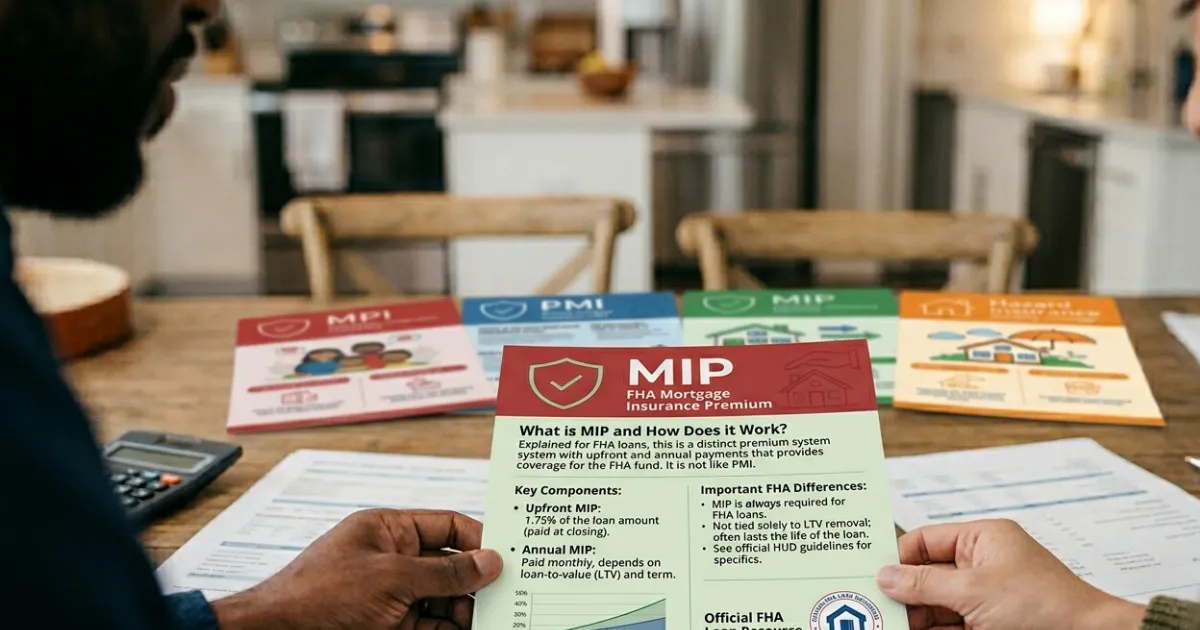
How Much Is FHA Mortgage Insurance in 2026?
There are two parts to MIP. You pay them separately, and you need to understand both.
Part 1: Upfront MIP. This is 1.75% of your loan amount. On a $300,000 loan, that’s $5,250. Most borrowers roll this into the loan rather than paying it at closing. But rolling it in means you’re paying interest on it for 30 years.
Part 2: Annual MIP. This gets divided into monthly payments added to your mortgage. For most 30-year FHA loans with less than 10% down, the annual rate is 0.55% of the loan balance. On a $290,000 balance, that’s about $132 per month.
| Loan Term | Down Payment | Annual MIP Rate | Duration |
|---|---|---|---|
| 30 years | Less than 10% | 0.55% | Life of loan |
| 30 years | 10% or more | 0.50% | 11 years |
| 15 years | Less than 10% | 0.15% – 0.40% | Life of loan |
| 15 years | 10% or more | 0.15% | 11 years |
Wait, that’s not quite right. I should clarify: the rates above come from the HUD guidelines updated in 2023 and still apply to loans originated in 2026. These rates replaced higher premiums that were in place before the February 2023 reduction of 30 basis points.
The key difference between MIP and PMI? MIP on FHA loans is often permanent if you put down less than 10%. You can’t cancel it by reaching 80% LTV. The only real way out is to refinance into a conventional loan once you’ve built enough equity.
Mortgage Insurance in Case of Death: What Actually Protects Your Family
This is where people get genuinely confused. And I understand why.
Does PMI protect your family if you die?
No. Absolutely not. PMI protects the lender, not your heirs. If you pass away, your lender gets paid by PMI only if your estate defaults on the loan. Your family doesn’t see a cent of it. They still owe the full mortgage balance.
The product that actually provides mortgage insurance in case of death is called Mortgage Protection Insurance, or MPI. It’s also called mortgage life insurance. And it’s completely optional. Nobody requires you to buy it.
How Mortgage Protection Insurance (MPI) Works
MPI is simple in concept. If you die, the policy pays off your remaining mortgage balance. Your family keeps the house. No more monthly payments. No forced sale.
Some policies also cover disability and job loss, adding a layer of payment protection while you’re still alive.
| Feature | PMI / MIP | Mortgage Protection Insurance (MPI) | Term Life Insurance |
|---|---|---|---|
| Protects | Lender | Your family / mortgage | Your family (flexible) |
| Required? | Yes (<20% down) | No | No |
| Death benefit | None for you | Pays off mortgage balance | Cash to beneficiaries |
| Medical exam? | N/A | Usually not required | Usually required |
| Benefit decreases? | N/A | Yes, as balance drops | No (level term) |
| Cost range | Varies | $25 – $150/month | Often cheaper for healthy borrowers |
Here’s the thing: for most healthy borrowers, a standard term life insurance policy is actually a better deal than MPI. The payout goes directly to your beneficiaries, not just to the mortgage. They can use it for funeral costs, income replacement, education, anything. MPI’s death benefit is restricted strictly to the mortgage balance.
But MPI has one major advantage: most policies guarantee acceptance without a medical exam. So if you have existing health conditions that make term life prohibitively expensive, MPI can be a real option worth considering.
2026 Tax Update: Beginning with the 2026 tax year, the deduction for mortgage insurance premiums, including PMI and MPI, was reinstated. If you itemize deductions and meet income requirements, you can write off premiums as mortgage interest. Consult your tax advisor for your specific situation.
What Is Mortgage Hazard Insurance and Why Does Your Lender Require It?
Look, this is the one that confuses people the most. Mortgage hazard insurance sounds like its own product. But it’s not really a separate policy.
Here’s the clearest way I can explain it: mortgage hazard insurance is just the structural coverage portion of your standard homeowners insurance policy. Lenders use the term “hazard insurance” specifically because they care about protecting the physical structure of your home. That structure is their collateral for the loan.
When your lender says “you need hazard insurance,” they’re asking you to get a homeowners insurance policy. Specifically, they want proof that Coverage A (dwelling coverage) is in place. That’s the part that pays to repair or rebuild your home if it’s damaged by fire, wind, hail, lightning, theft, vandalism, or other covered perils.
What Mortgage Hazard Insurance Covers
- Fire and smoke damage
- Wind and hail storms
- Lightning strikes
- Theft and vandalism
- Explosions
- Damage from vehicles or aircraft
And here’s what standard hazard coverage does NOT include:
- Flood damage (requires a separate flood insurance policy)
- Earthquake damage (requires separate earthquake coverage)
- Sewer backup (usually an optional add-on)
- Routine wear and tear
How Much Does Mortgage Hazard Insurance Cost?
Honestly, costs vary wildly by location, home age, construction type, and deductible. There’s no single national number I can give you. Your zip code is the biggest factor, especially in areas with high wildfire, hurricane, or tornado risk.
What I can tell you is that lenders typically require you to prepay the first year of hazard insurance at closing. It’s listed as a “prepaid item” on your loan estimate and closing disclosure. So budget for that upfront cost.
And fair enough, you might wonder: what if I skip hazard insurance after closing? Don’t. If your coverage lapses, your lender can purchase what’s called force-placed insurance on your behalf. And they will. That coverage is almost always far more expensive than what you’d pay on your own, and it protects the lender’s interest, not yours.
💡 Pro Tip
Get at least three to five hazard insurance quotes before closing. Rates can vary by hundreds of dollars per year for the same home. Compare carriers through your state’s insurance marketplace or use an independent broker who can shop multiple companies at once.
How Much Is Mortgage Insurance? Putting All the Numbers Together
You’re probably wondering: what does all of this actually add up to each month?
Let me walk you through a realistic scenario for a 2026 homebuyer so the numbers actually make sense.
Scenario: FHA Loan, 0,000 Purchase, 3.5% Down
| Cost Component | Monthly Amount | Annual Amount |
|---|---|---|
| Principal & Interest (6.5% rate) | ~$1,831 | ~$21,972 |
| FHA MIP (annual 0.55%) | ~$132 | ~$1,580 |
| Hazard Insurance (est.) | ~$150 | ~$1,800 |
| Property Taxes (est.) | ~$
250 |
~$3,000 |
| MPI (optional, death coverage) | ~$60 – $90 | ~$720 – $1,080 |
| Estimated Total Monthly Payment | ~$2,423 – $2,453 | ~$29,076 – $29,424 |
And don’t forget: the upfront FHA MIP of 1.75% adds $5,066 to your loan balance on day one (if financed). Over 30 years at 6.5%, that financed premium costs you closer to $11,500 in total interest. So the real cost of mortgage insurance on an FHA loan is substantially higher than the monthly line item suggests.
Scenario: Conventional Loan, 0,000 Purchase, 10% Down
With a 760+ credit score, your PMI rate might be around 0.30% to 0.50% annually. That’s roughly $75 to $125 per month. No upfront premium. And once you hit 80% LTV, it’s gone. That’s a much better deal over the long run for buyers with strong credit and a bit more to put down.
Insurance Mortgage Loan: What to Expect at Closing
When you’re closing on your insurance mortgage loan, there are a few insurance-related line items that tend to surprise first-time buyers. So let me walk through what you’ll actually see on your closing disclosure.
The thing is, none of this is hidden. Your lender is required to disclose all of these costs on your Loan Estimate (within three days of application) and again on your Closing Disclosure (at least three business days before closing). Read both documents carefully.
PMI vs MIP vs MPI vs Hazard Insurance: The Quick Comparison
If you’ve made it this far, you basically already know this. But let me pull it together one final time because it genuinely helps to see it all side by side.
| Question | PMI | MIP | MPI | Hazard Insurance |
|---|---|---|---|---|
| What loan type? | Conventional | FHA | Any | Any |
| Can you cancel? | Yes (at 80% LTV) | Limited | Yes (anytime) | Only after payoff |
| Upfront premium? | No (usually) | Yes (1.75%) | No | Yes (1st year at closing) |
| Who does it protect? | Lender | Lender | Your family | Home structure (lender’s collateral) |
| Pays if you die? | No | No | Yes | No |
Practical Tips to Minimize Your Mortgage Insurance Costs
Here’s where I want to give you something actually actionable, not just a pile of definitions.
1. Save to 20% Down on a Conventional Loan
This is the obvious one but it bears saying clearly. A 20% down payment eliminates PMI entirely on a conventional loan. On a $300,000 home, that’s $60,000 down. Hard to get there? Yes. Worth the financial planning effort? Absolutely.
2. Consider Lender-Paid PMI (LPMI)
Some lenders offer to pay your PMI in exchange for a slightly higher interest rate. There’s no monthly PMI line item, but the cost is baked into your rate permanently. This makes sense if you plan to sell or refinance within a few years before you’d otherwise cancel PMI.
3. Refinance Out of FHA Into Conventional
If you started with an FHA loan and have since built equity or improved your credit score, refinancing into a conventional loan can eliminate lifetime MIP and potentially get you a better rate. That’s essentially the only clean exit from FHA MIP for most borrowers.
4. Compare Hazard Insurance Before Your Rate Lock
Hazard insurance costs directly affect your monthly escrow. Shopping quotes early, ideally within the first week of going under contract, gives you real numbers before you commit. Don’t just accept the first quote.
5. Choose Term Life Over MPI If You’re Healthy
For borrowers in good health, a term life insurance policy with a death benefit matching your mortgage balance will almost always be cheaper and more flexible than mortgage protection insurance. The payout goes to your family, not just the bank.
Frequently Asked Questions
Final Thoughts
Mortgage insurance is one of those topics that sounds simple on the surface but gets complicated fast. You’ve now seen that there are four distinct products involved, PMI, MIP, MPI, and hazard insurance, and each one has different costs, different purposes, and different rules around cancellation.
The one thing I want you to take from this is that not all mortgage insurance is the same. PMI and MIP protect the lender. Hazard insurance protects the home structure. And only MPI actually protects your family if something happens to you.
So here’s my question for you: do you know exactly which types of mortgage insurance you’re currently paying for, and which ones you might actually need? If the answer is no, that’s worth a conversation with your loan officer this week.